What Is Speech Language Pathology?

Speech language pathology helps people of all ages communicate clearly and eat or drink safely. Speech Pathologists (often called “speechies”) work with children, adults, and older adults who find it hard to speak, understand language, use words, or swallow food and drinks.

We look at each person’s unique strengths and help them build the skills they need to share their thoughts, connect with others, and stay safe during mealtimes.

What Can a Speech Pathologist Help With?

Speech Pathologists help make everyday communication and eating easier. We support:
  • Speaking Clearly — Saying sounds correctly so family, teachers, and friends can understand them.
  • Understanding & Expressing Words — Following instructions, learning new words, and putting sentences together.
  • Using Communication Tools (AAC) — Using picture books, speech apps, or talker devices if speaking with voice is difficult.
  • Safe Eating & Drinking — Helping children and adults chew and swallow safely without choking.
  • Social Connections — Learning how to take turns in conversation, understand social cues, and make friends.
  • Reading & Spelling — Building early reading skills, learning letter sounds, and spelling words.
  • Stuttering & Voice — Helping speech flow smoothly and keeping the voice healthy, clear, and strong.

Common Communication & Swallowing Challenges We Support

Speech therapy isn’t just for complex disabilities. We help with everyday challenges like:
  • Unclear Speech — Trouble saying sounds like “r”, “s”, or “th”, or speech that sounds muffled.
  • Language Delays — Children who use few words, struggle to follow simple instructions, or have trouble making full sentences.
  • Stuttering — Bumpy speech where words or sounds get repeated, stuck, or stretched out.
  • Reading & Spelling Struggles — Difficulty learning letters, blending sounds together, or understanding what is read.
  • Swallowing & Choking Risks — Coughing or gagging while eating, difficulty chewing, or needing softer foods.
  • Picky or Fussy Eating — Children who are very anxious around new foods or stick to a very small list of textures.
  • Raspy or Tired Voice — Hoarseness, lost voice, or vocal strain from talking or singing.
  • Echolalia & Repeating Phrases — Children who learn language by repeating scripts or whole phrases from TV shows and movies (Gestalt Language Processing).

Understanding Aphasia and Dysphasia

Aphasia and Dysphasia are medical terms for language difficulties caused by changes in the brain.
  • Aphasia: A complete or severe difficulty understanding, speaking, reading, or writing language.
  • Dysphasia: A moderate language difficulty where a person can still use some language but finds it hard to find the right words or process complex sentences. (Note: This is different from Dysphagia, which refers to swallowing difficulties).
Common Causes
  • Stroke: The most frequent cause, happening when blood flow to the brain is blocked or interrupted.
  • Brain Injury: Head trauma from accidents, falls, or sports injuries.
  • Neurological Conditions: Brain tumors, infections, head or neck trauma, or progressive diseases like dementia.
How Speech Therapy Helps
Speech Pathologists work closely with individuals and families affected by aphasia or dysphasia to:
  • Rebuild lost language skills through targeted brain exercises and word-finding strategies.
  • Introduce practical alternative communication methods (such as communication books or digital devices) so the person can still express their needs.
  • Train family members and carers on effective ways to communicate, adapt conversations, and support independence.

Conditions Supported Across the Lifespan

Speech Pathologists work across diverse clinical populations, supporting both developmental and acquired conditions:
Pediatric & Lifespan Developmental Conditions
  • Developmental Language Disorder (DLD)
  • Speech Sound Disorders (Articulation delays, Phonological disorders)
  • Childhood Apraxia of Speech (CAS)
  • Autism Spectrum Disorder (ASD)
  • Attention-Deficit/Hyperactivity Disorder (ADHD)
  • Global Developmental Delay & Intellectual Disability
  • Cerebral Palsy & Physical Disabilities
  • Down Syndrome & Genetic Conditions
  • Hearing Loss & Hearing Impairments
  • Selective Mutism
Adult, Neurological & Acquired Conditions
  • Stroke & Acquired Brain Injury (ABI) (Aphasia, Dysarthria, Apraxia of Speech)
  • Parkinson’s Disease & Neurological Conditions (Motor speech, voice production, swallowing)
  • Dysphagia & Swallowing Disorders (Resulting from stroke, aging, or head/neck conditions)
  • Dementia & Cognitive-Linguistic Decline (Communication strategies, memory/cue books)
  • Voice Disorders & Vocal Cord Dysfunction
  • Motor Neuron Disease (MND / ALS) & Progressive Conditions
  • Tracheostomy & Complex Medical Needs

How Your Therapy Journey Works

Starting speech therapy is a structured, collaborative process designed to ensure every session delivers targeted, meaningful outcomes:
  1. Initial Consultation & Case History We start with a thorough conversation to discuss your main concerns, developmental background, medical history, and daily environment. We identify what matters most to you or your child in everyday life.
  2. Comprehensive Assessment Through standardized tests, clinical observation, language sampling, or mealtime trials, your speech pathologist identifies exact communication or swallowing strengths, challenges, and underlying prerequisites.
  3. Collaborative Goal Setting (SMART Goals) Together, we establish clear, functional, and measurable goals—whether that means speaking in 3-word sentences, improving speech clarity for school, safe swallowing at mealtimes, or mastering an AAC communication device.
  4. Targeted Therapy Blocks Clients attend scheduled therapy sessions (weekly, fortnightly, or intensive blocks) where structured, evidence-based activities and targeted exercises are used to build new skills step-by-step.
  5. Ongoing Feedback & Home Practice Every session includes practical debriefing and easy-to-follow strategies for parents, support workers, or partners to practice between appointments—maximizing real-world carryover.
  6. Progress Reviews & Re-Assessment We track data regularly to evaluate progress against your goals, updating plans as skills grow or preparing formal progress reports for NDIS plan reviews, school funding, or medical teams.

What Does a Typical Therapy Session Look Like?

Therapy sessions are engaging, highly structured, and tailored to the client’s age, interests, and individual communication goals. A standard 45-to-60-minute session generally follows this flow:
  • Warm-Up & Connect (5 mins): We start with a brief check-in to build rapport, review how home practice went during the week, and outline the visual schedule or plan for the day’s session.
  • Targeted Skill Building (30–40 mins):
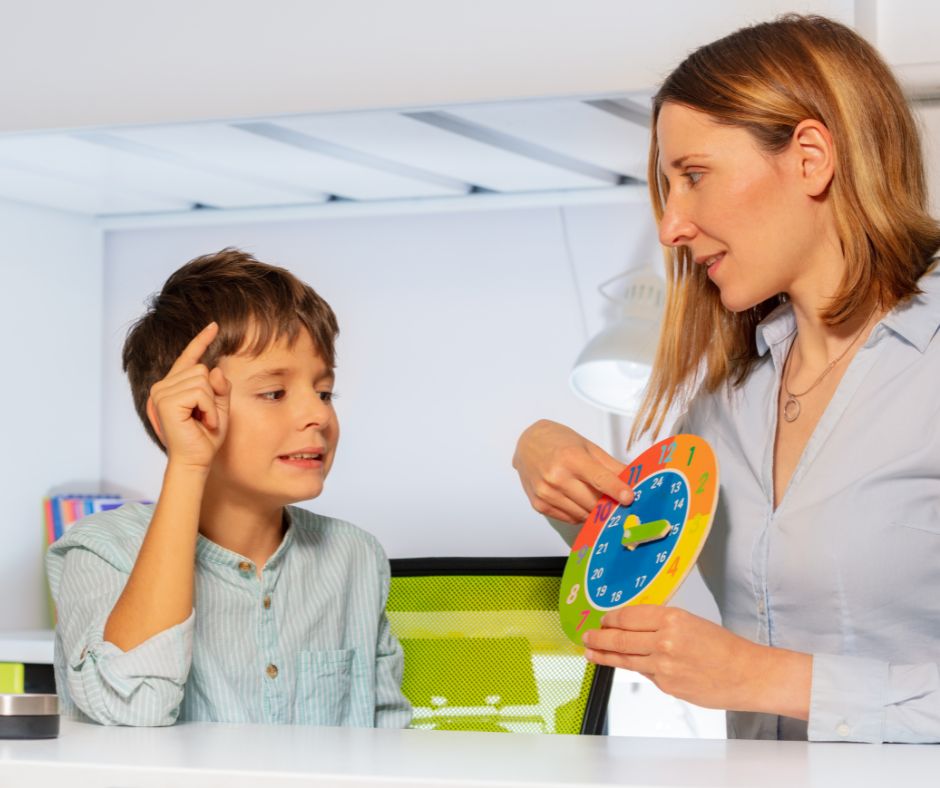
       – For Children: High-energy, play-based activities or structured games embedded with therapeutic repetitions—such as practicing speech sounds during a board game, modeling AAC vocabulary during pretend play, or working on sentence structure through storytelling.
       – For Adults: Functional, goal-focused tasks—such as voice production drills, language rehabilitation exercises for aphasia, memory and cognitive-communication strategies, or safe swallowing mechanics during mealtime practice.
  • Parent, Carer & Client Feedback (5–10 mins): We pause to discuss what went well during the session, demonstrate key techniques, and agree on simple, actionable strategies to carry over into daily routines at home, school, or work.

Multidisciplinary Care at Our Clinic

At our clinic, we believe in a collaborative, whole-person approach to care.
If your child receives other services—such as Occupational Therapy (OT) or Psychology—our speech pathologists work closely alongside the rest of your allied health team. We share insights, co-design goals, and embed consistent strategies across all disciplines. This team-based approach ensures that sensory needs, emotional regulation, and communication supports work together smoothly across every session.

Standardized SLP Assessments

Speech-Language Pathologists utilize standardized assessment tools, alongside clinical observations and language sampling, to form an accurate picture of a client’s profile:
  • Language Assessments: CELF-5 (Clinical Evaluation of Language Fundamentals), PLS-5 (Preschool Language Scales), and WAB-R (Western Aphasia Battery-Revised for adult language recovery).
  • Speech Sound & Motor Speech: GFTA-3 (Goldman-Fristoe Test of Articulation) and DEAP (Diagnostic Evaluation of Articulation and Phonology) to differentiate articulation delays from motor speech disorders like Apraxia.
  • Social Communication & Pragmatics: CCC-2 (Children’s Communication Checklist) and TOPL-2 (Test of Pragmatic Language) to evaluate social reasoning and conversational context.
  • Literacy & Phonological Processing: CTOPP-2 (Comprehensive Test of Phonological Processing) and YARC (York Assessment of Reading for Comprehension) for reading and decoding challenges.
  • AAC Feature-Matching: Structured trials assessing high-tech speech-generating devices (e.g., TouchChat, Proloquo2Go, LAMP) and low-tech communication books matched to physical, visual, and cognitive needs for Assistive Technology funding.

SLP REPORTS & DOCUMENTATION

Speech Pathologists produce tailored, evidence-based clinical documentation designed for NDIS plan reviews, diagnostic clarity, educational support applications, and multidisciplinary care:
  • Full Comprehensive SLP Assessment Report
    ◦ Details: Complete diagnostic background, standardized assessment scores, clinical observations, functional impact analysis, and structured, measurable long-term/short-term SMART goals.
    ◦ Purpose: Initiating NDIS funding applications, supporting diagnostic assessments (e.g., DLD, Autism, Speech Sound Disorders), and establishing baseline therapy goals.
  • Progress & NDIS Re-Assessment Summary Report
    ◦ Details: Outlines outcome measures, tracks progress against functional goals, documents ongoing clinical necessity, and recommends support funding for the next NDIS plan period.
    ◦ Purpose: Submitted to NDIS planners and Local Area Coordinators (LACs) for annual plan reviews or plan variations.
  • AAC Assessment & Assistive Technology Justification Report
    ◦ Details: In-depth evaluation detailing device trial outcomes, feature-matching analysis, trial data, and clinical justification for speech-generating hardware or specialized software.
    ◦ Purpose: Submitted to the NDIS Assistive Technology panel for equipment funding approval.
  • School Readiness and education Report
    ◦ Educational and school-based assessments can provide valuable insights into a child’s learning, development, communication, behaviour, sensory needs, and ability to participate in educational settings. These assessments may be recommended when families, educators, or healthcare professionals have concerns about a child’s readiness for childcare, preschool, kindergarten, or school, or when additional support strategies are needed to help them succeed.
    ◦ Assessment findings can assist in identifying strengths and areas of need, informing practical recommendations and tailored strategies for use at home, childcare, and school. They can also help families and schools determine the most appropriate educational setting, whether that be a mainstream classroom with adjustments and support, a support unit, or a specialist educational placement. Our team works collaboratively with families and educators to ensure recommendations are meaningful, practical, and focused on helping each child reach their full potential.
  • Dysphagia & Mealtime Management Plan
    ◦ Details: Detailed clinical assessment of chewing, swallowing safety, recommended IDDSI food and fluid textures, and mealtime supervision protocols.
    ◦ Purpose: Used by families, school staff, support workers, and residential care teams to ensure mealtime safety.